


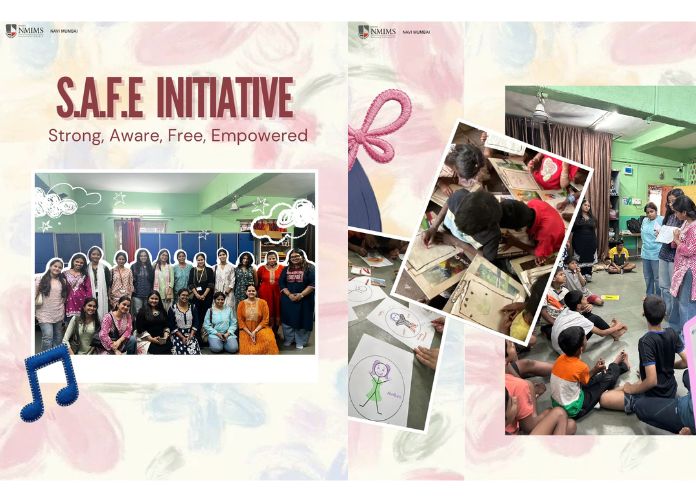
The Public Relations Committee of the School of Liberal Arts at SVKM’s NMIMS Navi Mumbai successfully organised the ‘S.A.F.E’ (Strong, Aware, Free, Empowered) Initiative, a structured community outreach programme designed to empower children and adolescents through interactive learning on personal hygiene, body safety, emotional awareness, and decision-making. The initiative aimed to create a safe, inclusive, and stigma-free environment where children could actively participate, express themselves, and build confidence.
Interactive and Child-Centric Learning Approach
The programme adopted a play-based and reflective methodology to ensure effective engagement. Activities such as storytelling, drawing, movement exercises, sorting games, and guided group discussions were used to address everyday practices related to health, personal boundaries, emotional regulation, and safety awareness.
Special emphasis was placed on inclusivity, ensuring participation across diverse age groups and language backgrounds. The use of visual aids, simple vocabulary, and peer-supported learning techniques helped make the sessions accessible, engaging, and impactful for all participants.
Experiential Learning for Student Volunteers
The initiative provided meaningful real-world exposure to student volunteers, enabling them to apply academic knowledge in practical settings. Students developed essential skills in facilitation, communication, leadership, teamwork, and ethical engagement while working directly with children from diverse community backgrounds.
Through this hands-on experience, students applied psychological concepts such as emotional awareness, self-regulation, autonomy, and safety education, strengthening their readiness for future careers in psychology, social work, education, and allied professional fields.
Strengthening Community Partnerships and Institutional Impact
The programme also enhanced NMIMS Navi Mumbai’s visibility as an institution committed to socially responsive and value-driven education. It strengthened partnerships with local NGOs by offering a well-structured, professionally facilitated intervention tailored to children’s developmental needs. The collaboration opened pathways for continued academic–community engagement and future outreach initiatives.
Sustainable Value and Community Outcomes
The S.A.F.E initiative created long-term value through the development of reusable activity modules, worksheets, visual aids, and facilitation frameworks that can be adapted for future community programmes. The initiative also followed mindful resource usage practices by relying primarily on low-cost, reusable materials, minimising environmental impact.
The programme directly benefitted 85 children and adolescents and involved 29 student volunteers. Participants gained practical knowledge on hygiene practices, personal safety, emotional awareness, and help-seeking behaviours, contributing to stronger confidence, awareness, and overall wellbeing within the community.

