


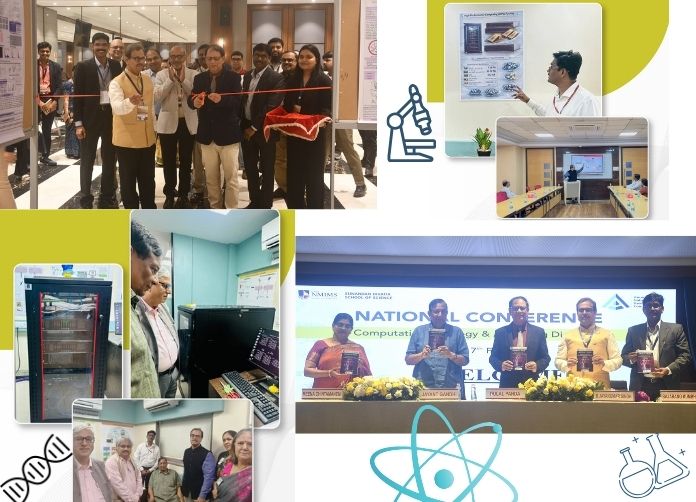
SVKM’s NMIMS Sunandan Divatia School of Science successfully organized the National Conference on “Computational Biology and Artificial Intelligence in Drug Discovery – 2026 (CBAIDD-26)”, with support from the Anusandhan National Research Foundation (ANRF). The conference brought together experts from academia and industry to deliberate on emerging technologies such as machine learning, molecular simulations, and data-driven modeling, promoting translational research and advancing AI-enabled drug discovery and precision healthcare.
Dr. Bajarang Kumbhar, Assistant Professor at the Sunandan Divatia School of Science, NMIMS, is a recipient of research funding from ANRF, further strengthening the institution’s growing footprint in computational and interdisciplinary biomedical research.
The two-day conference served as a platform for knowledge exchange and collaborative dialogue. The national conference featured talks by eminent speakers from premier institutions such as IIT Bombay, JNU Delhi, NIPER Mohali, IISER Pune, CDAC Pune, TIFR, IIT BHU, IIIT Delhi, ACTREC, University of Delhi, and NIRRCH, showcasing a depth of expertise along with opportunities for meaningful academic–industry interaction.
The aim of the conference was to foster interdisciplinary collaboration, promote translational research and healthcare applications, showcase breakthroughs and innovations, while bridging the gap between academia, industry, and clinicians. It acted as a platform to bring together researchers, academicians, industry professionals, and students to discuss recent advances and emerging trends in computational biology, AI and machine learning in biology, genomics, proteomics, artificial intelligence, NGS data analysis, and drug discovery, with a strong emphasis on interdisciplinary research and innovation in healthcare.
In conjunction with the conference, SVKM’s NMIMS inaugurated a state-of-the-art High-Performance Computing (HPC) Facility at the Sunandan Divatia School of Science. The establishment of this advanced facility highlights the University’s commitment to enhancing computational infrastructure and fostering cutting-edge research and training in computational biology and interdisciplinary life sciences. The HPC facility has been developed with generous funding support from the Indian Council of Medical Research (ICMR) and SVKM’s NMIMS. Dr. Bajarang Kumbhar has also been awarded sanctioned research grants from both ANRF and ICMR, reflecting a strong institutional and national commitment to advancing high-end computational capabilities in biomedical and translational research.
University officials highlighted that the HPC facility will play a pivotal role in enhancing research capabilities, fostering interdisciplinary collaboration, and building computational skills among students and faculty. The initiative aligns with NMIMS’ commitment to academic excellence, innovation, and impactful research, while complementing ICMR’s mission to advance healthcare and biomedical research through scientific infrastructure development.
Dr. Jayakumar Singh Bondili, Dean, Sunandan Divatia School of Science, NMIMS, shares, “CBAIDD-26 reflects our vision of integrating artificial intelligence with life sciences to address the various challenges in healthcare and share knowledge on drug discovery. The inauguration of the HPC facility also marks a significant step for our institution as it helps us empower students, researchers, and faculty with advanced technology and state-of-the-art infrastructure. We are looking forward to continuing contributing meaningfully to the drug discovery research in India while advancing our biomedical research.”
The newly inaugurated HPC facility will support cutting-edge research in areas such as molecular modelling and simulations, drug discovery, genomics, and artificial intelligence–driven biological data analysis. The facility is expected to serve as a hub for research, training, and collaborative projects with academic, clinical, and industry partners, contributing meaningfully to the national research ecosystem. The facility will also enable skill development, interdisciplinary collaboration, and academic research among faculty, students, and external research partners.

