


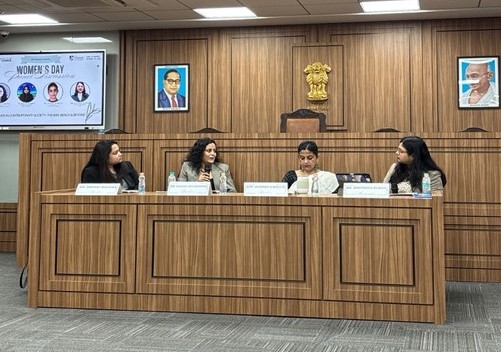
Marking International Women’s Day, the SVKM’s NMIMS Kirit P. Mehta School of Law organised a thought-provoking panel discussion titled “Women in Contemporary Society: Bar, Bench and Beyond.” Held at the Moot Court Room in the Old Mukesh Patel Building, the session brought together legal practitioners, academicians, and students to engage in meaningful dialogue on the evolving role of women in professional and social spaces.
Examining Women’s Position in Professional Spaces
The discussion aimed to explore the structural and societal challenges women continue to face in contemporary society, particularly within the legal profession and corporate environments. Around 60 third-year students from the BA LL.B. (Hons.) and BBA LL.B. (Hons.) programmes participated in the session, which was organised by the Student Council under the mentorship of Mr. Akshat Chaturvedi.
Insights from Industry and Legal Experts
The panel featured distinguished speakers including Ms. Roopal Kulshrestha, Partner at Shardul Amarchand Mangaldas & Co.; Ms. Heenal Wadhwa, Principal Associate at The Law Point; and Adv. Audrey D’Mello, Director at Majlis. The discussion was moderated by Ms. Akanksha Kumar, Assistant Professor at NMIMS Kirit P. Mehta School of Law, who guided the conversation through several key themes affecting women in professional environments.
Policies, Protections and Workplace Realities
One of the central themes was the implementation of maternity leave policies and labour protections in corporate organisations. Panelists discussed the importance of such policies in supporting women employees while also addressing debates around the financial and operational responsibilities of organisations in implementing them.
The panel also addressed workplace safety, particularly the requirement of consent for women working night shifts and the infrastructural safeguards necessary to ensure safe working conditions. Speakers emphasised that professional opportunities should not be limited by safety concerns and highlighted the need for robust institutional support systems.
Debating Emerging Workplace Policies
The conversation further explored menstrual leave policies and the broader challenge of achieving work-life balance for women who often manage professional responsibilities alongside caregiving roles. Panelists discussed how such policies must be designed thoughtfully to avoid reinforcing stereotypes while still addressing genuine health and well-being concerns.
A significant portion of the discussion focused on sexual harassment prevention and the implementation of the POSH (Prevention of Sexual Harassment) framework. While acknowledging that the law has created formal mechanisms for redressal, speakers highlighted practical challenges such as lack of awareness, fear of retaliation, and organisational biases that may hinder effective implementation.
Addressing Patriarchy and Structural Inequality
The panelists also reflected on the role of social conditioning and systemic privilege in shaping gender disparities. They noted that entrenched patriarchal norms often influence career progression and leadership representation, contributing to the relatively lower presence of women in senior positions across sectors.
The session remained highly interactive, with students actively engaging in discussions around gender dynamics in workplaces, representation in leadership roles, and the need for stronger institutional frameworks that move beyond symbolic equality toward meaningful empowerment.
A Call for Collective Responsibility
The discussion concluded with the Dean delivering the vote of thanks and expressing appreciation to the panelists for sharing their insights and experiences. She also acknowledged the students for their enthusiastic participation and emphasised the importance of continued dialogue on gender equality.
The Women’s Day panel ultimately reinforced the need for awareness, policy reforms, and collective responsibility to ensure that women are able to participate fully, safely, and equitably in all spheres of professional life.

