


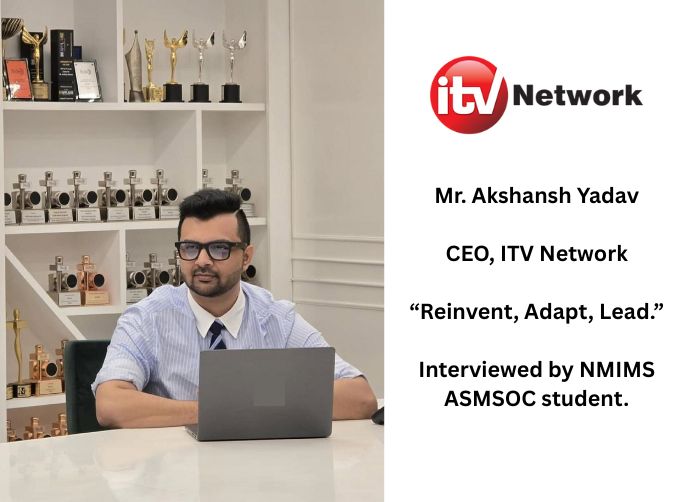
A student-led conversation with Mr. Akshansh Yadav, CEO, ITV Network, by 2nd Year BBA students of the Anil Surendra Modi School of Commerce (ASMSOC), NMIMS Mumbai.
If you ask Mr. Akshansh Yadav how he became one of the youngest CEOs in Indian media, you won’t hear a dramatic origin story or a rehearsed success mantra. Instead, his answer is refreshingly practical and slightly uncomfortable.
“You need to reinvent yourself every two or three years,” he says matter-of-factly. “Otherwise, you become redundant.”
In an industry that never sleeps, this mindset isn’t optional. It’s survival.
As CEO of ITV Network, and with prior experience driving digital transformation at India Today and Z Media, Yadav operates at the intersection of real-time news, digital behaviour, and rapidly evolving technology. His leadership philosophy reflects this reality — constant learning, calculated risk-taking, and the willingness to move across ecosystems before comfort sets in.
Never Stop Upskilling
For Mr. Yadav, rapid career growth was never about age or ambition alone. It was about staying relevant in ecosystems that change faster than job titles.
“The learning curve has to be constant,” he explains. “The digital segment, especially with the advent of AI, is evolving at a breakneck speed.”
What sets his journey apart is not just depth, but range. From digital media to fintech, automobiles, and OEMs, his career has spanned industries that often sit on opposite sides of the table. That exposure has shaped how he views media today.
Having worked with sectors that are among the largest advertisers in Indian news, he understands what brands truly look for — and how content, distribution, and monetisation intersect. The result is a leadership style that blends editorial instinct with commercial awareness, without compromising either.
Why Digital Transformation Starts with People
Despite leading some of India’s most significant digital news shifts, Yadav is clear about one thing: transformation doesn’t begin with tools.
“Every organisation has its own DNA,” he says. “You need to understand the nature of the beast.”
In news media, that “beast” operates 24/7. Breaking news doesn’t follow office hours, and work-life balance, in the conventional sense, doesn’t always exist. This reality often clashes with the expectations Gen Z and Millennials bring from other industries — fixed hours, clean boundaries, and predictable schedules.
Yadav doesn’t dismiss these expectations. Instead, he contextualises them.
For him, transformation depends on hiring not just for skill, but for intent — people who are genuinely passionate about news, digital audiences, and impact. When late nights are unavoidable, his approach remains simple and human: compensate meaningfully through time off, offsite breaks, and space to reset.
Balance, he believes, doesn’t have to look the same everywhere. It just has to be fair.
“Once you get the right people,” he says, “you can drive transformation anywhere.”
‘Delulu’ Is Not a Joke
When asked about Gen Z being labelled “delulu” for dreaming big and moving fast, Yadav doesn’t hesitate.
“We should all be delusional,” he says with a smile. “I am all up for it.”
For him, delusion isn’t denial — it’s belief before evidence. A decade ago, he wouldn’t have imagined himself leading one of India’s biggest media networks either. Yet, that belief mattered.
He adds a crucial qualifier that turns a viral term into a leadership lesson:
“Delusion without audacity does not work.”
Dreaming alone is harmless. Acting when opportunity appears is what changes trajectories. Delusion gives you vision; audacity gives you momentum. Together, they create outcomes. It’s a thought that resonates deeply with young professionals navigating uncertainty, speed, and expectation overload.
How News Consumption Keeps Moving — And Where It’s Headed
To explain the future of digital media, Yadav draws a sharp political analogy.
- 2014: Elections were fought on television.
- 2019: The shift moved to Facebook and viral video, powered by cheap data.
- 2024: WhatsApp groups shaped collective consciousness.
“And 2029?” he says. “It’s anybody’s guess.”
The same evolution applies to news consumption. From apps to websites to social platforms, news no longer comes from a single destination — it finds you, whether through Instagram, X, or a forwarded message.
According to Yadav, the next phase is already taking shape: AI-powered hyper-personalisation.
“AI-driven automated bots will serve as personal assistants,” he explains. “They’ll decide what you consume.”
What this looks like in practice is still unfolding. But one thing is clear — leaders who fail to adapt their mindset will be left behind.
What Students Took Away from the Conversation
For NMIMS students preparing to enter fast-evolving industries, the conversation offered insights that went far beyond career milestones or titles.
• Reinvention is not optional — it’s recurring.
• Digital transformation is cultural before it’s technical.
• Delusion is powerful only when paired with audacity.
• Distribution matters as much as content.
• Hyper-personalisation is the next frontier — but human judgment still leads.
Mr. Akshansh Yadav’s journey isn’t a story about becoming the youngest CEO. It’s about earning relevance repeatedly in a system that resets every few years.
And perhaps that’s the most useful lesson for students today:
In fast-moving industries, comfort is temporary — curiosity is permanent.
Student Contributors:
Mr. Hrig Paliwal
Mr. Om Sharma
Mr. Shubh Shah
Ms. Ananya Rathod
Anil Surendra Modi School of Commerce (ASMSOC),
2nd Year BBA

