


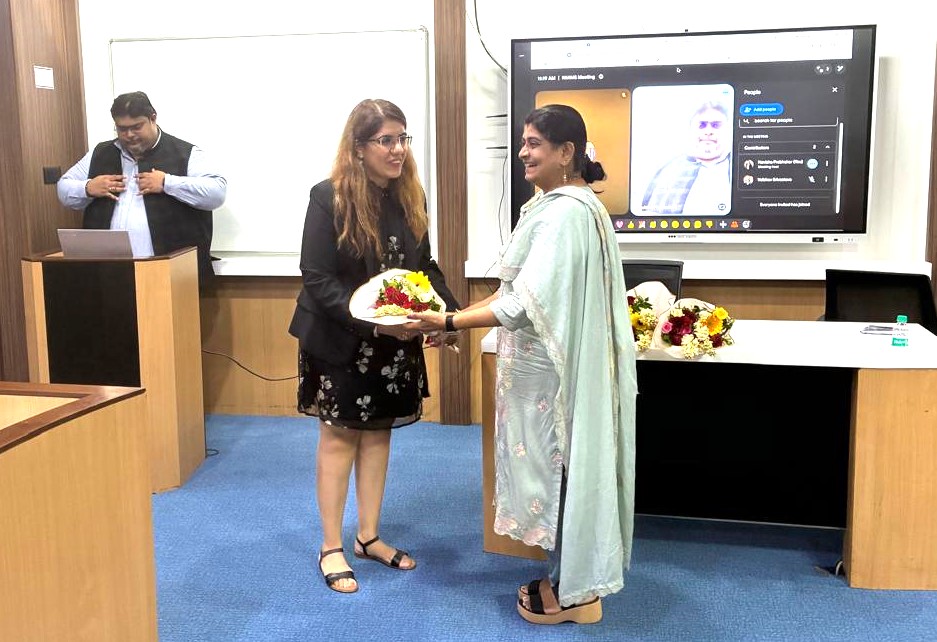
A report on the Leadership Workshop held at NMIMS Deemed-to-be University on July 8, 2026, facilitated by Deloitte in association with Google Cloud.
In Charge, Department of Soft Skills
August 8, 2026
Every institution of consequence eventually faces a moment when the tools of the age change faster than the habits of the profession. For higher education, that moment is now. Artificial intelligence has moved from the laboratory to the lecture hall, from the research paper to the registrar’s desk and the question before university leadership is no longer whether to engage with it, but how to do so deliberately, ethically and at scale.
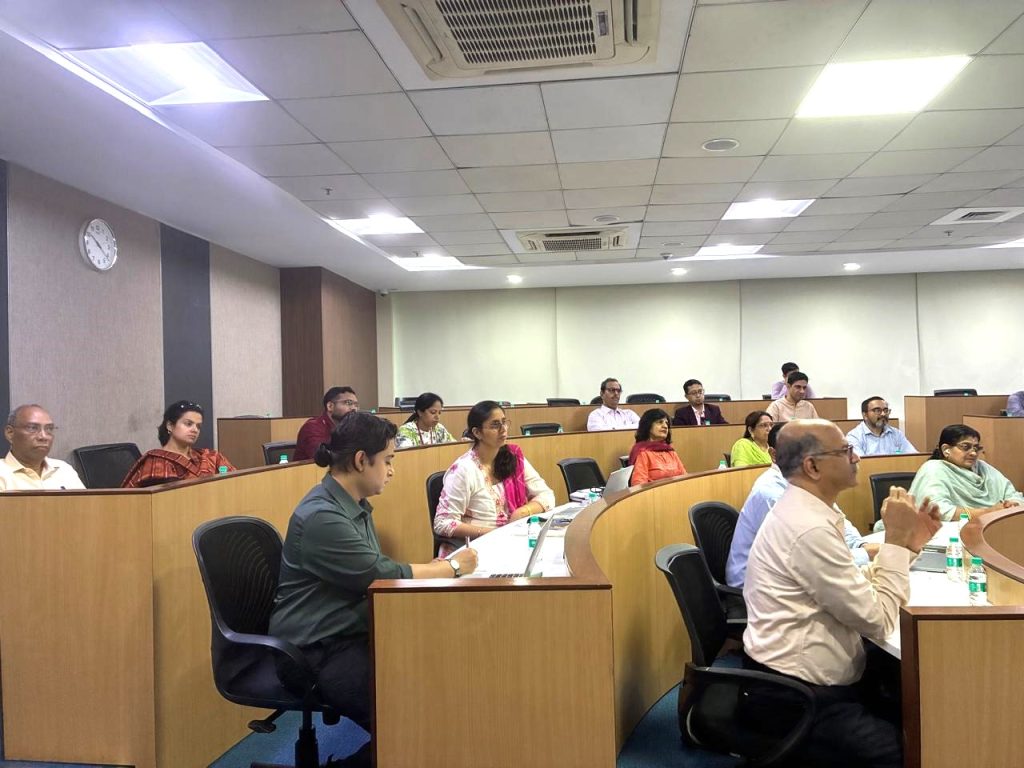
It was in this spirit that NMIMS Deemed-to-be University hosted “University of the Future: Leveraging Artificial Intelligence,” a leadership workshop conducted on July 8, 2026, from 10:00 AM to 1:30 PM. The session brought together the University’s senior management and academic leadership including Vice Chancellor and Pro Vice Chancellors, the Registrar, the Controller of Examinations, Directors, Deans, Heads of Departments and senior faculty members for a morning of structured immersion into what AI means for the university as an institution.
Demystifying the Machine
The workshop opened not with technology, but with history. Participants were taken through seventy-five years of artificial intelligence the people, the setbacks, the quiet breakthroughs and the sudden accelerations that have brought us to the present moment. It was a deliberate choice of framing: to understand where AI is going, one must first appreciate how long it has been coming. From there, the session moved into the vocabulary of the field. Machine learning and generative AI, supervised and unsupervised learning, reinforcement learning and neural networks. Transformers, tokens, temperature and context windows. Retrieval-augmented generation, embeddings and vector knowledge maps. And, crucially, the concepts that govern responsible adoption; hallucination, bias, observability, data privacy, sovereignty, and the enduring principle of the human in the loop.
For a leadership audience, this grounding proved invaluable. Strategic decisions about AI cannot be delegated to vocabulary one does not possess. By the end of the segment, terms that had circulated as jargon had become instruments of judgement.
From Concept to Capability
The second movement of the workshop was a live demonstration of what these technologies can already do in a university context. Participants watched a single source chapter transform, in minutes, into a summary, a set of sub-modules, a lesson plan, a quiz, a deck of flashcards, a multilingual podcast, a video, a mind map, an infographic and a presentation. They saw an interactive query-response system built on a prescribed text, allowing a student to interrogate the material conversationally rather than linearly. They saw images, slides and videos generated to illuminate a difficult concept, and adaptive explanations that adjusted to the learner’s pace.
Perhaps most striking for an administrative audience were the demonstrations of vibe coding building working applications for everyday university needs, such as a teaching-case generator or an answer-script evaluator, without traditional software development. The session closed its demonstration segment with 3D video avatars and a discussion of their emerging role in instruction and student engagement.
A deeper exploration of Gemini Enterprise followed, examining specific, deployable use cases across the university value chain admissions, academic delivery, examinations, student services and administration with attention to what implementation would realistically require.
An Engaged Room
What distinguished the morning was not the content alone but the quality of the conversation around it. The introductory session on artificial intelligence, led by Dr. Kamlesh Vyas, was widely regarded as the intellectual anchor of the workshop lucid, wide-ranging and grounded in practice. It drew a steady stream of questions from the floor, and the NMIMS management and leadership team engaged actively throughout, probing not only what AI can do but what a university ought to do with it.
The discussion ranged across pedagogy and assessment integrity, faculty readiness and workload, data governance and student privacy, and the institutional architecture required to move from isolated experiments to coherent strategy. These are precisely the questions that separate genuine transformation from technological theatre, and the room did not shy away from them.
The workshop concluded with a collective reflection on the path forward: how NMIMS will leverage AI at an overall institutional level, and what the next one to three years of AI development are likely to make possible. Proceedings then continued informally over lunch at the EDR, where conversations begun in the session carried on an unhurried hour of networking that, as often happens, produced its own share of ideas.
The Road Ahead
The University of the Future will not be defined by the number of tools it deploys. It will be defined by the clarity of its vision and the discipline with which technology is made to serve that vision; for students, for faculty and for those who administer the institution. The workshop’s most valuable contribution may simply have been to establish a shared language and a shared frame of reference among the people who will make those decisions at NMIMS.
Acknowledgements
The University gratefully acknowledges the leadership and encouragement that made this workshop possible.
Our sincere thanks to Dr. Meena Chintamaneni, Acting Vice Chancellor and Pro Vice Chancellor, NMIMS, whose vision and steady support shaped both the intent and the ambition of this session. We are equally grateful to Dr. Sharad Mhaiskar, Provost, Administration, NMIMS, and Dr. Abhishek Ranjan, Pro Vice Chancellor, NMIMS, for their guidance and active participation, which set the tone for the engagement that followed.
A special word of gratitude is due to Dr. Kamlesh Vyas of Deloitte, who facilitated the workshop with remarkable clarity and generosity of expertise, and who brought the Google Cloud team on board to conduct the sessions. Our thanks also to the facilitating team; Vaibhav Srivastava, Navisha Prabhakar and Pratiksha Anand for a morning that was as practical as it was thought-provoking.

