


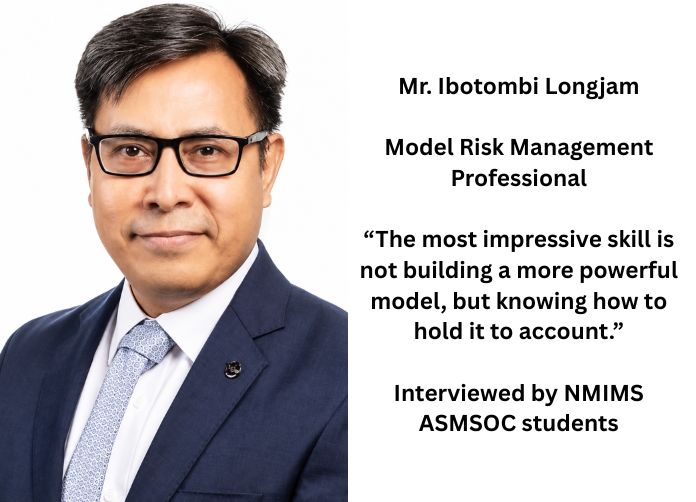
In a domain where a single flawed model can set off consequences felt across entire portfolios, where regulators watch with exacting precision and the stakes are nothing short of institutional, the professional who stands between a powerful algorithm and a consequential decision carries a burden that is rarely understood from the outside. It demands technical depth, philosophical clarity, and an ethical steadiness that no certification can fully confer. For the students of NMIMS ASMSOC, a conversation with Mr. Ibotombi Longjam, a seasoned Model Risk Management professional, offered not just a window into this world, but a masterclass in thinking about it honestly.
When AI Enters the Room, Familiar Risks Get Louder
Models, Longjam reminded us, have always sat at the heart of financial decision-making. What is changing is the nature of those models. Artificial intelligence and machine learning, now deployed widely across marketing analytics, credit decisions, and fraud detection, have introduced capabilities that traditional governance frameworks were never designed to contain. Longjam noted that models can sometimes be approved through established validation processes while questions may remain around the transparency and explainability of their decision-making.
Before naming AI’s specific dangers, Longjam grounded the conversation in what model risk actually means under SR 11-7, the Federal Reserve’s foundational guidance on the subject. At its core, it is the potential for adverse consequences from decisions based on incorrect or misused model outputs. The sources of that risk are twofold: a model that is technically or conceptually flawed, and a model that is used incorrectly applied outside its intended scope, over-relied upon, or left uncalibrated as the world it was trained on quietly shifts. His point was pointed: even a sound model, placed in the hands of poor governance, will eventually mislead.
“AI amplifies risks related to explainability, dynamic bias, and data drift. These risks are not entirely new, but AI accelerates their emergence, makes them harder to detect, and allows them to materialize between validation cycles.”
— Ibotombi Longjam
What AI does, in his framing, is not create new categories of risk so much as amplify and accelerate the old ones. Many AI models are inherently opaque their logic non-linear, their decision boundaries invisible to the human eye. This creates the unsettling possibility that a model passes every formal validation checkpoint while remaining genuinely ununderstood. Bias hides in the interaction effects that linear diagnostics miss entirely. Data drift accumulates in silence while headline performance metrics continue to look healthy. The model appears stable. The model is not stable.
For practitioners, this is not merely a technical challenge. It is a governance challenge of the first order, and Longjam was clear-eyed about it: models may be approved without true understanding of how they make decisions, and that approval, however procedurally correct, carries real risk into the world.
The Ledger Has Two Sides
Longjam is not a pessimist on artificial intelligence. His view is rigorous, not alarmist. In fraud analytics, he sees perhaps the most compelling case for AI’s value in finance: machine learning models that process vast transaction volumes in real time, adapt continuously to evolving fraud tactics, and flag suspicious patterns in seconds often reducing false positives and preventing losses that rule-based systems, by their very nature, cannot anticipate. The speed, the adaptability, and the scale are simply beyond what traditional approaches can match.
In credit risk, deep transactional data enables more granular scoring, faster lending decisions, and early warning signals during economic shifts that help institutions reposition before losses crystallise. And within Model Risk Management itself, AI-powered automation can reduce the cycle times of ongoing monitoring and annual reviews by as much as thirty to forty percent, freeing validators to spend their energy on the work that actually requires human judgment: effective challenge.
The message Longjam offered was not to fear AI, but to govern it with the same rigour we have always demanded of the models that drive financial decisions. The competitive advantage is real. So is the responsibility that comes with it.
The Project That Would Stand Apart
When asked which academic project would impress him most as a demonstration of capability for MRM, a study on algorithmic bias, an analysis of time-series forecasting, or a framework for Model Explainability Longjam’s answer was unambiguous, though characteristically reasoned.
Explainability, he argued, sits at the exact intersection of AI’s greatest risk and the validator’s core responsibility. An XAI framework is not merely a technical exercise it is a structured effort to make opaque models legible, to give validators and regulators the tools to understand, trust, and genuinely challenge the outputs of systems that would otherwise remain black boxes. In credit scoring, where regulatory scrutiny is intense and adverse action requirements carry the force of law, that legibility is not optional. It is the foundation on which any defensible decision rests.
“While it is essential to have solid knowledge of traditional modelling techniques, expertise in XAI clearly brings advanced and differentiated
skill sets that are increasingly relevant for MRM.”
— Ibotombi Longjam
The deeper lesson for aspiring practitioners is embedded in this preference. The highest-value skill in Model Risk Management is not the one that helps you build a more powerful model. It is the one that helps you hold that model to account. That is, at its core, what the discipline exists to do.
The True Validator Is a Philosophy, Not a Title
In a field reshaped by new regulatory guidance and new technologies on an almost annual cadence, Longjam’s philosophy on staying relevant cuts cleanly through the noise. “I am always excited,” he said, “to see individuals who demonstrate the qualities of a true validator.” Not someone who has mastered the latest framework or earned the most recent certification, but someone who understands why a model fails, appreciates its assumptions and limitations, and remains closely attuned to the evolution of regulatory expectations.
These core philosophical skills the disposition toward rigour, toward genuine understanding, toward asking the questions that others find inconvenient form the foundation on which everything else must rest. Continuous learning, in his view, is not about chasing new techniques for their own sake. It is about reinforcing those foundational values and then acquiring the tools necessary to apply them in a world that keeps changing around you. MRM professionals are not remembered for the tools they mastered. They are remembered for the models they refused to let pass.
On certifications, his perspective was measured. They signal commitment and foundational knowledge, and that signal carries real weight. But he places considerably more value on something that cannot be credentialled: the depth of understanding evidenced by actual work, and the ability to explain and defend one’s thinking under scrutiny. Candidates who can speak with passion and precision about a project they have genuinely grappled with almost always leave a stronger impression than those who arrive with impressive initials but shallow roots.
Hard on the Issues, Soft on the People
Asked to name the two qualitative attributes he considers non-negotiable for success in Model Risk Management, Longjam did not hesitate. The first is a disposition toward depth: being detail-oriented and genuinely willing to dig. MRM is not a field that rewards the surface. The work demands patience with complexity, the willingness to trace a model failure to its root cause even when the path is long and the institutional pressure to approve is real.
The second is rarer and, in many ways, harder to cultivate. Being hard on the issues but soft on the people. Model Risk professionals sit at a crossroads between risk, technology, business, and finance and they must push back, sometimes firmly, without fracturing the relationships that make governance work over time. It is a quality that requires both intellectual courage and interpersonal maturity, and Longjam’s point was clear: in the best practitioners, these two things are not in tension. They are inseparable.
Ibotombi Longjam’s counsel, taken together, forms a portrait of a profession that demands more than technical skill. It demands a way of thinking rigorous, honest, and patient that treats models not as outputs to be approved but as arguments to be interrogated. For every student at NMIMS ASMSOC considering a path into risk and finance, his message is both a compass and a standard: the most impressive thing you can offer is not what you know, but how deeply and honestly you know it, and how courageously you are willing to say so.
Student Contributors

