


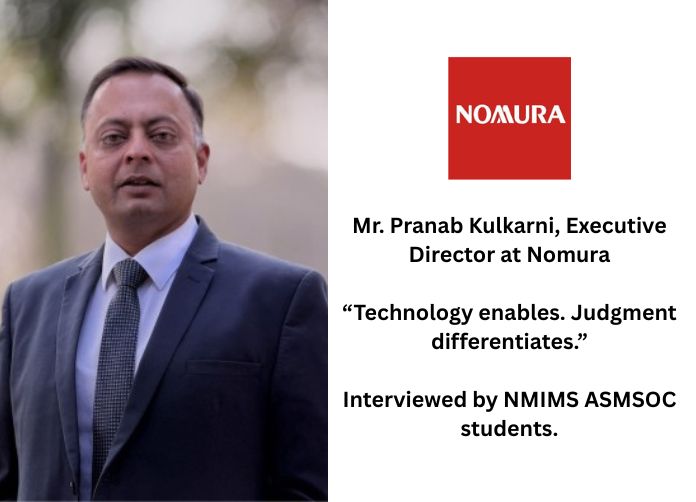
A compelling student led conversation with Mr. Pranab Kulkarni, Executive Director at Nomura, offered far more than an industry perspective. It revealed the principles, discipline, and clarity of thought that define enduring success in global finance. Drawing from extensive experience across markets and geographies, Mr. Kulkarni shared reflections on operational excellence, leadership, and the evolving relationship between technology and human judgment.
From Foundations to Real World Responsibility
Mr. Kulkarni described the transition from academics to corporate life as one of the most defining phases of any young professional’s journey. In classrooms, achievement is measured through scores and structured performance. In the professional world, however, one is entrusted with real assets, client confidence, and institutional reputation.
He emphasized that careers are not built merely on qualifications, but on consistency, accountability, and sound judgment. Strong fundamentals developed early become the base upon which long term credibility is established.
Navigating Complexity in a Technology Driven Environment
In an era shaped by automation and constant innovation, Mr. Kulkarni noted that the greatest challenge is not the availability of data, but the ability to convert it into meaningful intelligence. Information may be abundant, yet insight remains rare.
While technology can accelerate execution and improve efficiency, true value still emerges from thoughtful interpretation. Professionals who combine analytical sharpness with commercial understanding will continue to stand apart in an increasingly digital world.
Balancing Risk, Regulation, and Profitability
Reflecting on his experience in inventory optimization and stock lending, Mr. Kulkarni explained that balancing risk, regulation, and profitability is ultimately an exercise in intelligent design. Sustainable institutions do not view these priorities as opposing forces, but as elements that must work in harmony.
Efficient balance sheets, disciplined cost structures, operational precision, and strategic market focus together create lasting profitability. Success is achieved not by avoiding constraints, but by performing exceptionally within them.
Automation, AI, and the Human Mindset
Speaking on transformation, Mr. Kulkarni underscored that successful automation begins with simplifying processes and identifying repetitive work that can be redesigned with strong controls. When implemented thoughtfully, such initiatives reduce manual effort, improve transparency, and enhance speed.
Yet he observed that the greatest obstacle is seldom technology itself. It is mindset. When individuals understand that automation elevates human capability rather than diminishes it, progress becomes both faster and more meaningful.
Leading Across Borders and Cultures
Having led teams across multiple geographies, Mr. Kulkarni highlighted that leadership, at its core, is universal. While cultures may differ in communication and approach, respect remains constant.
He noted that the most effective leaders listen carefully, adapt intelligently, and create common ground across diverse environments. Global credibility is earned not through authority alone, but through empathy, professionalism, and consistency.
Education, Certifications, and Continuous Growth
On professional qualifications, Mr. Kulkarni acknowledged that programs offered by CFA Institute and GARP provide valuable structure and technical depth. They can open doors and strengthen one’s foundation.
However, he made it clear that credentials alone do not define distinction. What truly separates professionals is the ability to apply knowledge with clarity, communicate effectively, and deliver consistently with integrity.
Advice for Future Leaders in Finance
For students aspiring to enter the world of finance, his guidance was both practical and timeless. Build strong fundamentals. Understand your work deeply. Do not rush growth at the expense of depth.
He also stressed the importance of mentors, humility, calmness under pressure, and continuous learning. In a rapidly changing world, technical skills will evolve, but character will always remain a lasting advantage.
Student Contributors

